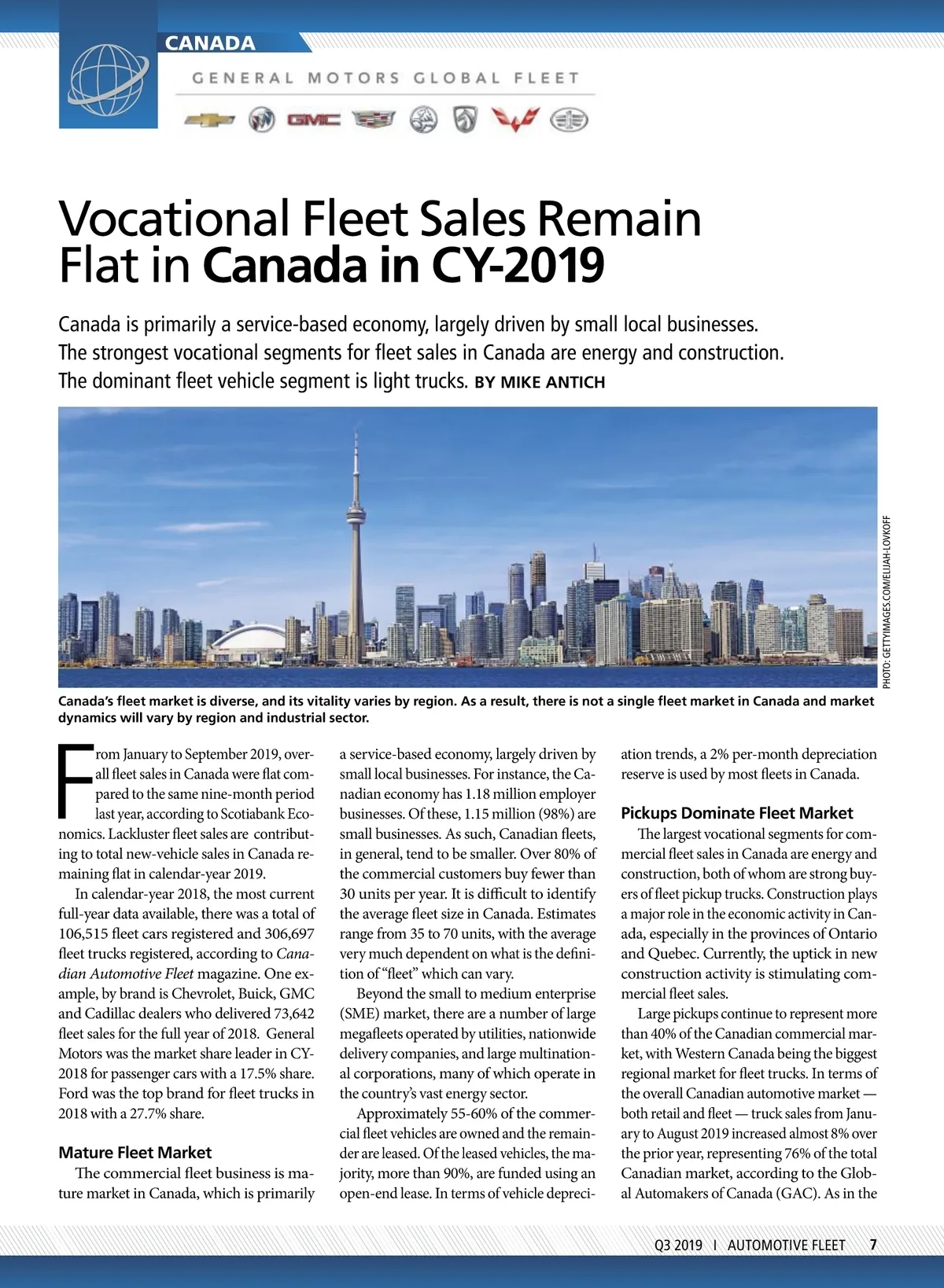
CANADA Vocational Fleet Sales Remain Flat in Canada in CY-2019 Canada is primarily a service-based economy, largely driven by small local businesses. T he strongest vocational segments for leet sales in Canada are energy and construction. The dominant leet vehicle segment is light trucks. BY MIKE ANTICH Canada’s leet market is diverse, and its vitality varies by region. As a result, there is not a single leet market in Canada and market dynamics will vary by region and industrial sector. F rom January to September 2019, over-al l leet sales in Canada were lat com-pared to the same nine-month period last year, according to Scotiabank Eco-nomics. Lackluster leet sales are contribut-ing to total new-vehicle sales in Canada re-maining lat in calendar-year 2019. In calendar-year 2018, the most current full-year data available, there was a total of 106,515 leet cars registered and 306,697 leet trucks registered, according to Cana-dian Automotive Fleet magazine. One ex-ample, by brand is Chevrolet, Buick, GMC and Cadillac dealers who delivered 73,642 leet sales for the full year of 2018. General Motors was the market share leader in CY-2018 for passenger cars with a 17.5% share. Ford was the top brand for leet trucks in 2018 with a 27.7% share. Mature Fleet Market he commercial leet business is ma-ture market in Canada, which is primarily a service-based economy, largely driven by small local businesses. For instance, the Ca-nadian economy has 1.18 million employer businesses. Of these, 1.15 million (98%) are small businesses. As such, Canadian leets, in general, tend to be smaller. Over 80% of the commercial customers buy fewer than 30 units per year. It is diicult to identify the average leet size in Canada. Estimates range from 35 to 70 units, with the average very much dependent on what is the deini-tion of “leet” which can vary. Beyond the small to medium enterprise (SME) market, there are a number of large megaleets operated by utilities, nationwide delivery companies, and large multination-al corporations, many of which operate in the country’s vast energy sector. Approximately 55-60% of the commer-cial leet vehicles are owned and the remain-der are leased. Of the leased vehicles, the ma-jority, more than 90%, are funded using an open-end lease. In terms of vehicle depreci-ation trends, a 2% per-month depreciation reserve is used by most leets in Canada. Pickups Dominate Fleet Market he largest vocational segments for com-mercial leet sales in Canada are energy and construction, both of whom are strong buy-ers of leet pickup trucks. Construction plays a major role in the economic activity in Can-ada, especially in the provinces of Ontario and Quebec. Currently, the uptick in new construction activity is stimulating com-mercial leet sales. Large pickups continue to represent more than 40% of the Canadian commercial mar-ket, with Western Canada being the biggest regional market for leet trucks. In terms of the overall Canadian automotive market — both retail and leet — truck sales from Janu-ary to August 2019 increased almost 8% over the prior year, representing 76% of the total Canadian market, according to the Glob-al Automakers of Canada (GAC). As in the Q3 2019 I AUTOMOTIVE FLEET 7 PHOTO: GETTYIMAGES.COM/ELIJAH-LOVKOFF
Automotive Fleet Nov 2019: 7