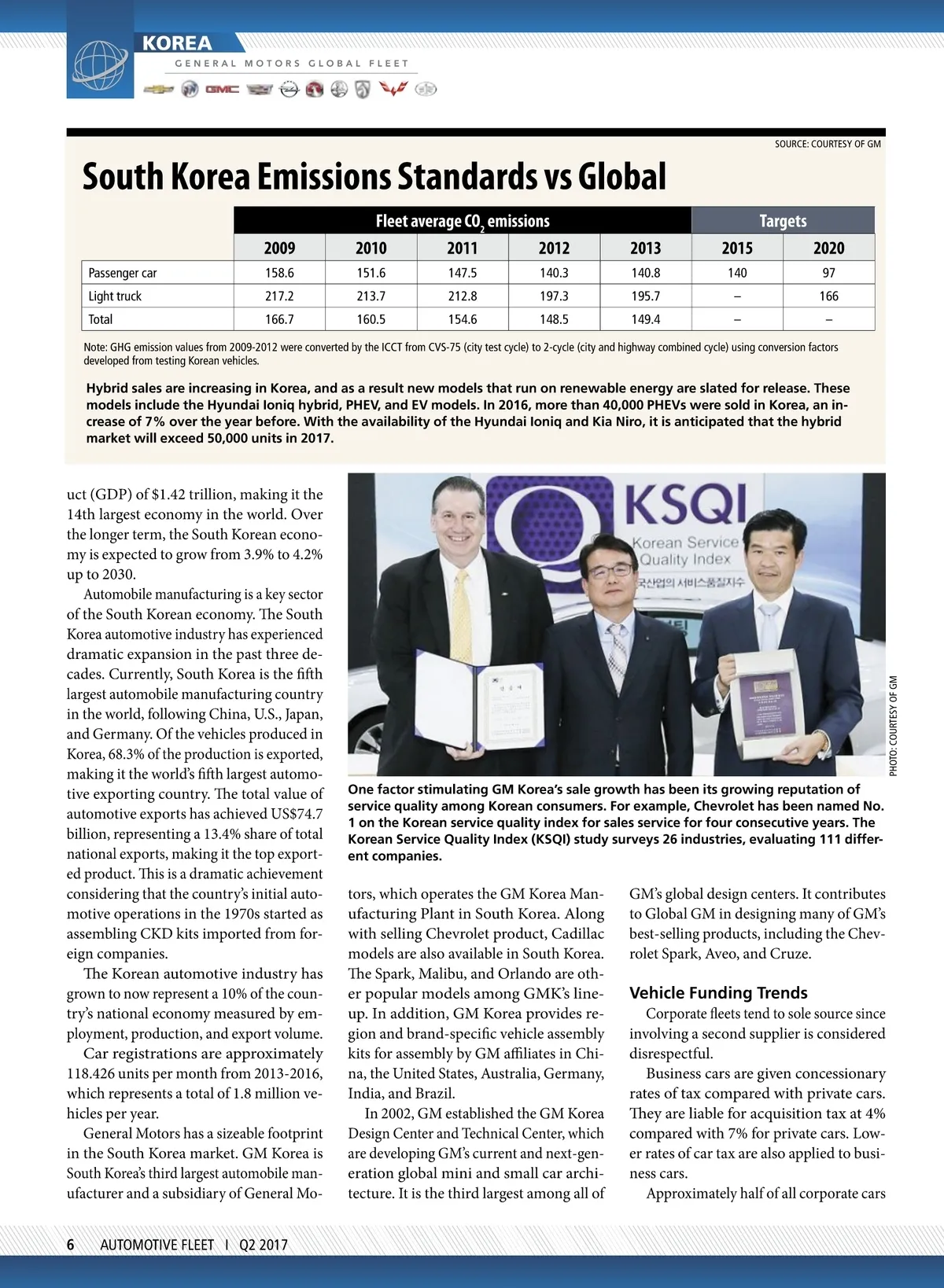
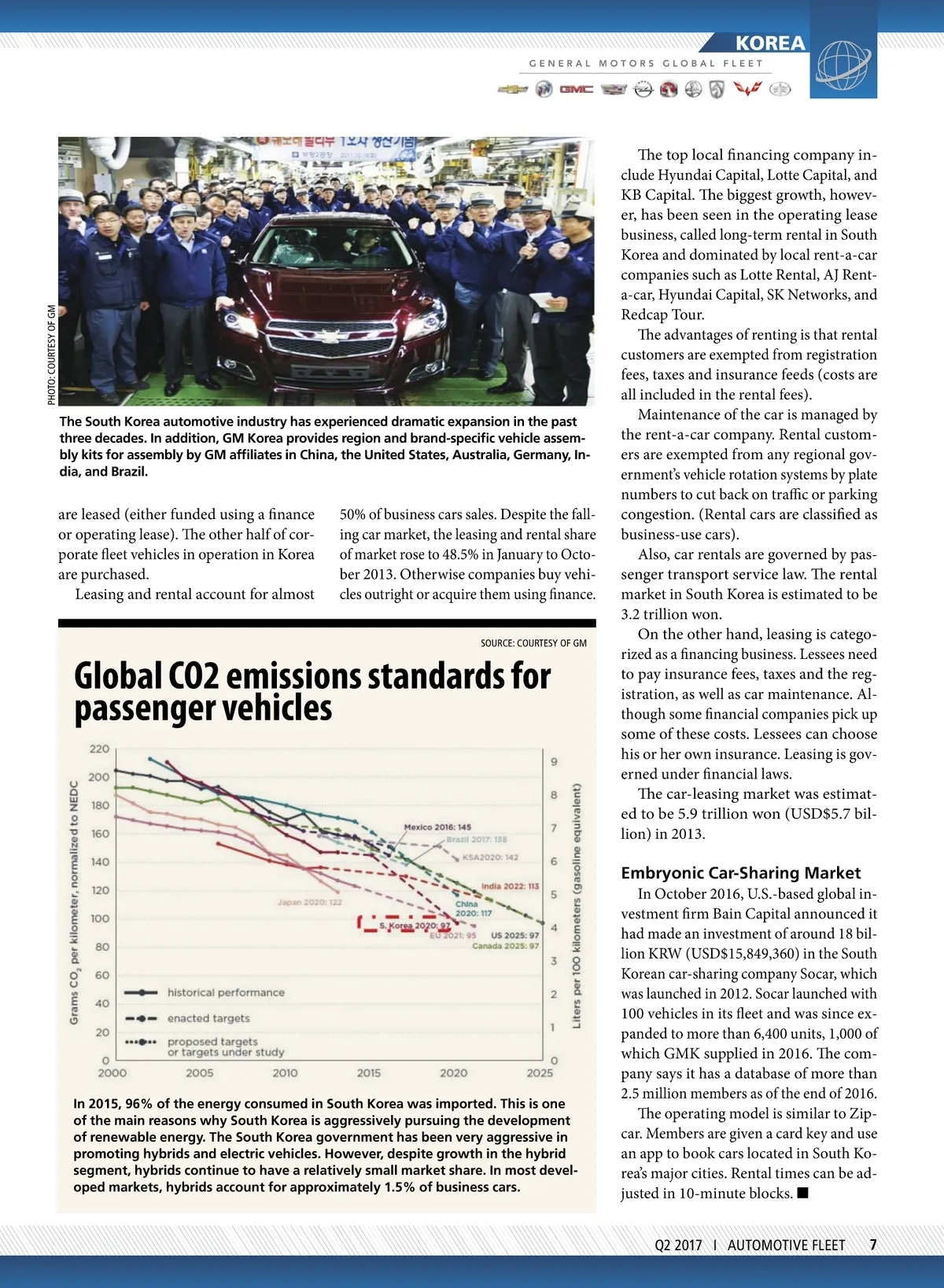
KOREA The South Korea automotive industry has experienced dramatic expansion in the past three decades. In addition, GM Korea provides region and brand-speciic vehicle assem-bly kits for assembly by GM afiliates in China, the United States, Australia, Germany, In-dia, and Brazil. are leased (either funded using a inance or operating lease). he other half of cor-porate leet vehicles in operation in Korea are purchased. Leasing and rental account for almost 50% of business cars sales. Despite the fall-ing car market, the leasing and rental share of market rose to 48.5% in January to Octo-ber 2013. Otherwise companies buy vehi-cles outright or acquire them using inance. SOURCE: COURTESY OF GM Global CO2 emissions standards for passenger vehicles he top local inancing company in-clude Hyundai Capital, Lotte Capital, and KB Capital. he biggest growth, howev-er, has been seen in the operating lease business, called long-term rental in South Korea and dominated by local rent-a-car companies such as Lotte Rental, AJ Rent-a-car, Hyundai Capital, SK Networks, and Redcap Tour. he advantages of renting is that rental customers are exempted from registration fees, taxes and insurance feeds (costs are all included in the rental fees). Maintenance of the car is managed by the rent-a-car company. Rental custom-ers are exempted from any regional gov-ernment’s vehicle rotation systems by plate numbers to cut back on traic or parking congestion. (Rental cars are classiied as business-use cars). Also, car rentals are governed by pas-senger transport service law. he rental market in South Korea is estimated to be 3.2 trillion won. On the other hand, leasing is catego-rized as a inancing business. Lessees need to pay insurance fees, taxes and the reg-istration, as well as car maintenance. Al-though some inancial companies pick up some of these costs. Lessees can choose his or her own insurance. Leasing is gov-erned under inancial laws. he car-leasing market was estimat-ed to be 5.9 trillion won (USD$5.7 bil-lion) in 2013. PHOTO: COURTESY OF GM Embryonic Car-Sharing Market In October 2016, U.S.-based global in-vestment irm Bain Capital announced it had made an investment of around 18 bil-lion KRW (USD$15,849,360) in the South Korean car-sharing company Socar, which was launched in 2012. Socar launched with 100 vehicles in its leet and was since ex-panded to more than 6,400 units, 1,000 of which GMK supplied in 2016. he com-pany says it has a database of more than 2.5 million members as of the end of 2016. he operating model is similar to Zip-car. Members are given a card key and use an app to book cars located in South Ko-rea’s major cities. Rental times can be ad-justed in 10-minute blocks. ■ Q2 2017 I AUTOMOTIVE FLEET 7 In 2015, 96% of the energy consumed in South Korea was imported. This is one of the main reasons why South Korea is aggressively pursuing the development of renewable energy. The South Korea government has been very aggressive in promoting hybrids and electric vehicles. However, despite growth in the hybrid segment, hybrids continue to have a relatively small market share. In most devel-oped markets, hybrids account for approximately 1.5% of business cars.
Automotive Fleet May 2017: Page 7