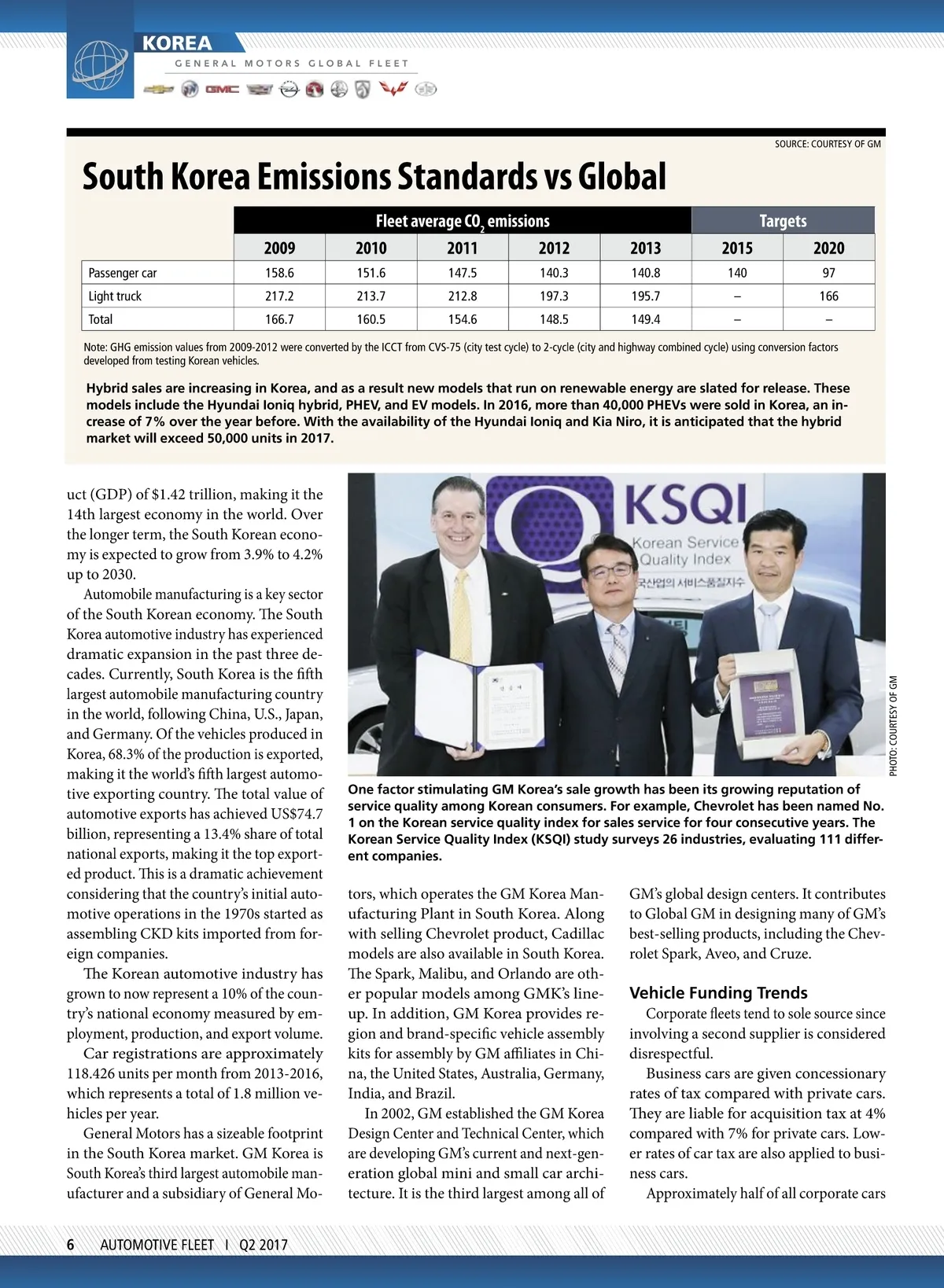
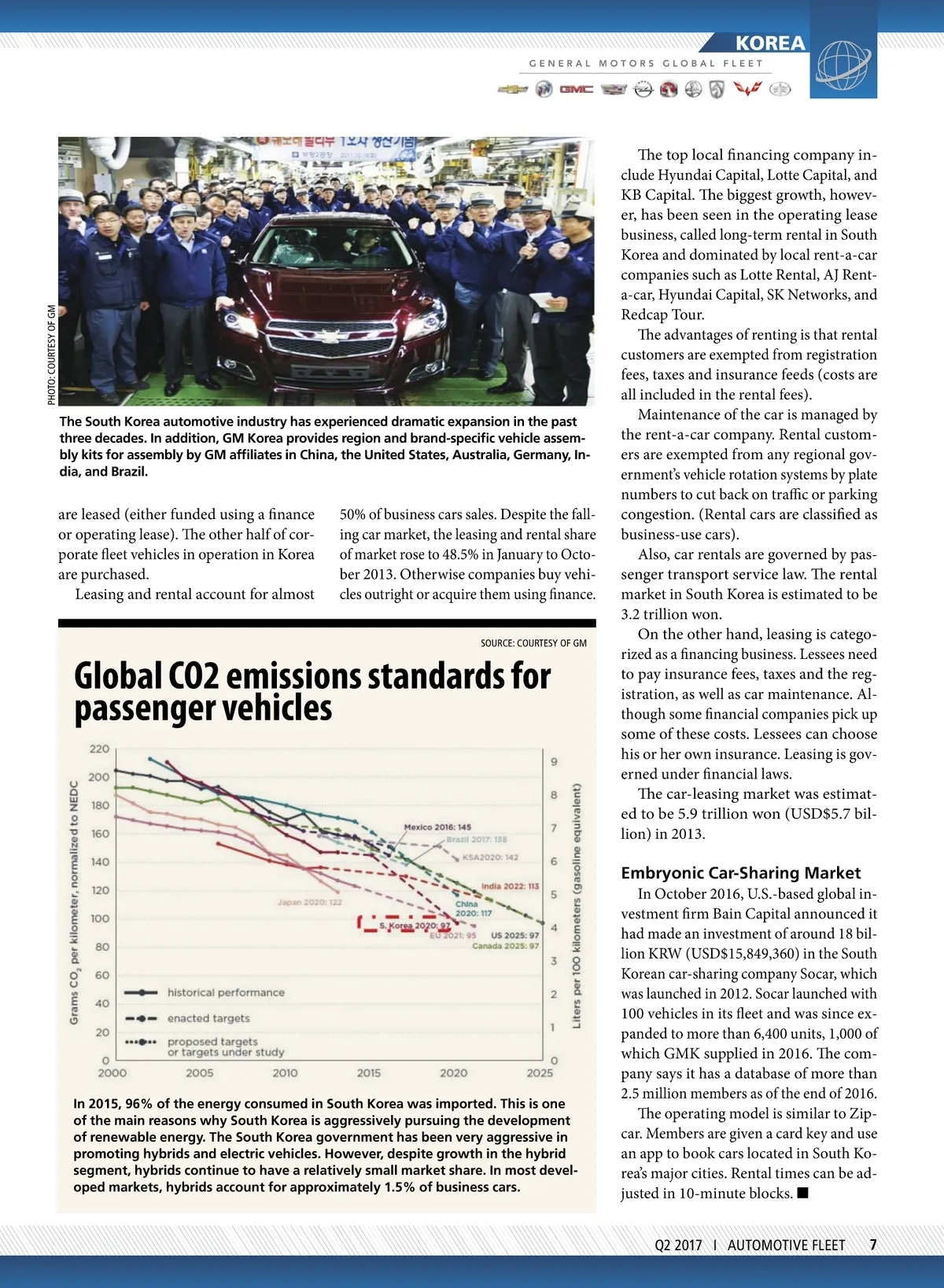
KOREA SOURCE: COURTESY OF GM South Korea Emissions Standards vs Global 2009 Passenger car Light truck Total 158.6 217.2 166.7 Fleet average CO 2 emissions 2010 2011 2012 151.6 213.7 160.5 147.5 212.8 154.6 140.3 197.3 148.5 Targets 2013 140.8 195.7 149.4 2015 140 – – 2020 97 166 – Note: GHG emission values from 2009-2012 were converted by the ICCT from CVS-75 (city test cycle) to 2-cycle (city and highway combined cycle) using conversion factors developed from testing Korean vehicles. Hybrid sales are increasing in Korea, and as a result new models that run on renewable energy are slated for release. These models include the Hyundai Ioniq hybrid, PHEV, and EV models. In 2016, more than 40,000 PHEVs were sold in Korea, an in-crease of 7% over the year before. With the availability of the Hyundai Ioniq and Kia Niro, it is anticipated that the hybrid market will exceed 50,000 units in 2017. uct (GDP) of $1.42 trillion, making it the 14th largest economy in the world. Over the longer term, the South Korean econo-my is expected to grow from 3.9% to 4.2% up to 2030. Automobile manufacturing is a key sector of the South Korean economy. he South Korea automotive industry has experienced dramatic expansion in the past three de-cades. Currently, South Korea is the ith largest automobile manufacturing country in the world, following China, U.S., Japan, and Germany. Of the vehicles produced in Korea, 68.3% of the production is exported, making it the world’s ith largest automo-tive exporting country. he total value of automotive exports has achieved US$74.7 billion, representing a 13.4% share of total national exports, making it the top export-ed product. his is a dramatic achievement considering that the country’s initial auto-motive operations in the 1970s started as assembling CKD kits imported from for-eign companies. he Korean automotive industry has grown to now represent a 10% of the coun-try’s national economy measured by em-ployment, production, and export volume. Car registrations are approximately 118.426 units per month from 2013-2016, which represents a total of 1.8 million ve-hicles per year. General Motors has a sizeable footprint in the South Korea market. GM Korea is South Korea’s third largest automobile man-ufacturer and a subsidiary of General Mo-6 AUTOMOTIVE FLEET I Q2 2017 One factor stimulating GM Korea’s sale growth has been its growing reputation of service quality among Korean consumers. For example, Chevrolet has been named No. 1 on the Korean service quality index for sales service for four consecutive years. The Korean Service Quality Index (KSQI) study surveys 26 industries, evaluating 111 differ-ent companies. tors, which operates the GM Korea Man-ufacturing Plant in South Korea. Along with selling Chevrolet product, Cadillac models are also available in South Korea. he Spark, Malibu, and Orlando are oth-er popular models among GMK’s line-up. In addition, GM Korea provides re-gion and brand-speciic vehicle assembly kits for assembly by GM ailiates in Chi-na, the United States, Australia, Germany, India, and Brazil. In 2002, GM established the GM Korea Design Center and Technical Center, which are developing GM’s current and next-gen-eration global mini and small car archi-tecture. It is the third largest among all of GM’s global design centers. It contributes to Global GM in designing many of GM’s best-selling products, including the Chev-rolet Spark, Aveo, and Cruze. Vehicle Funding Trends Corporate leets tend to sole source since involving a second supplier is considered disrespectful. Business cars are given concessionary rates of tax compared with private cars. hey are liable for acquisition tax at 4% compared with 7% for private cars. Low-er rates of car tax are also applied to busi-ness cars. Approximately half of all corporate cars PHOTO: COURTESY OF GM
Automotive Fleet May 2017: Page 6