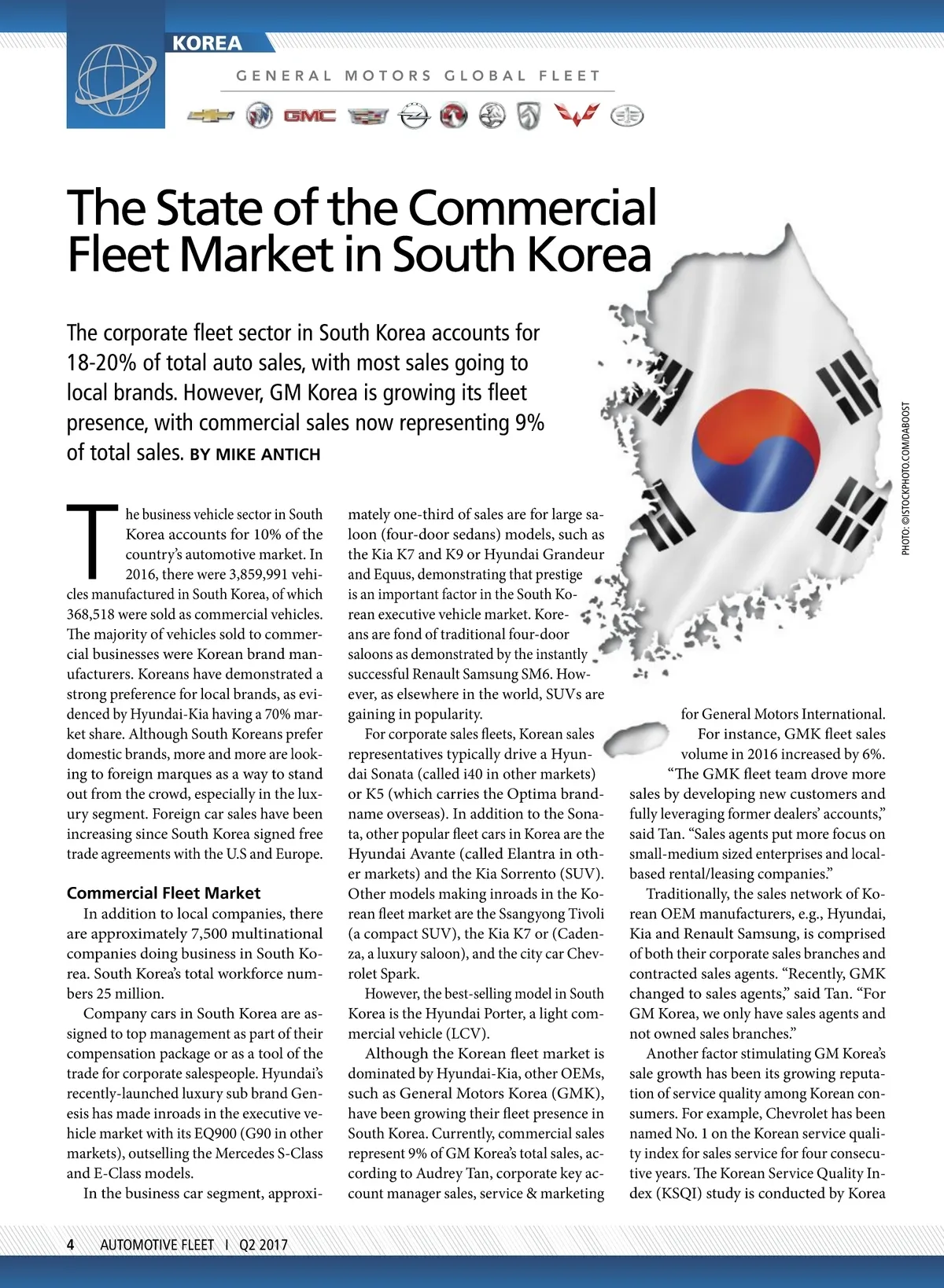
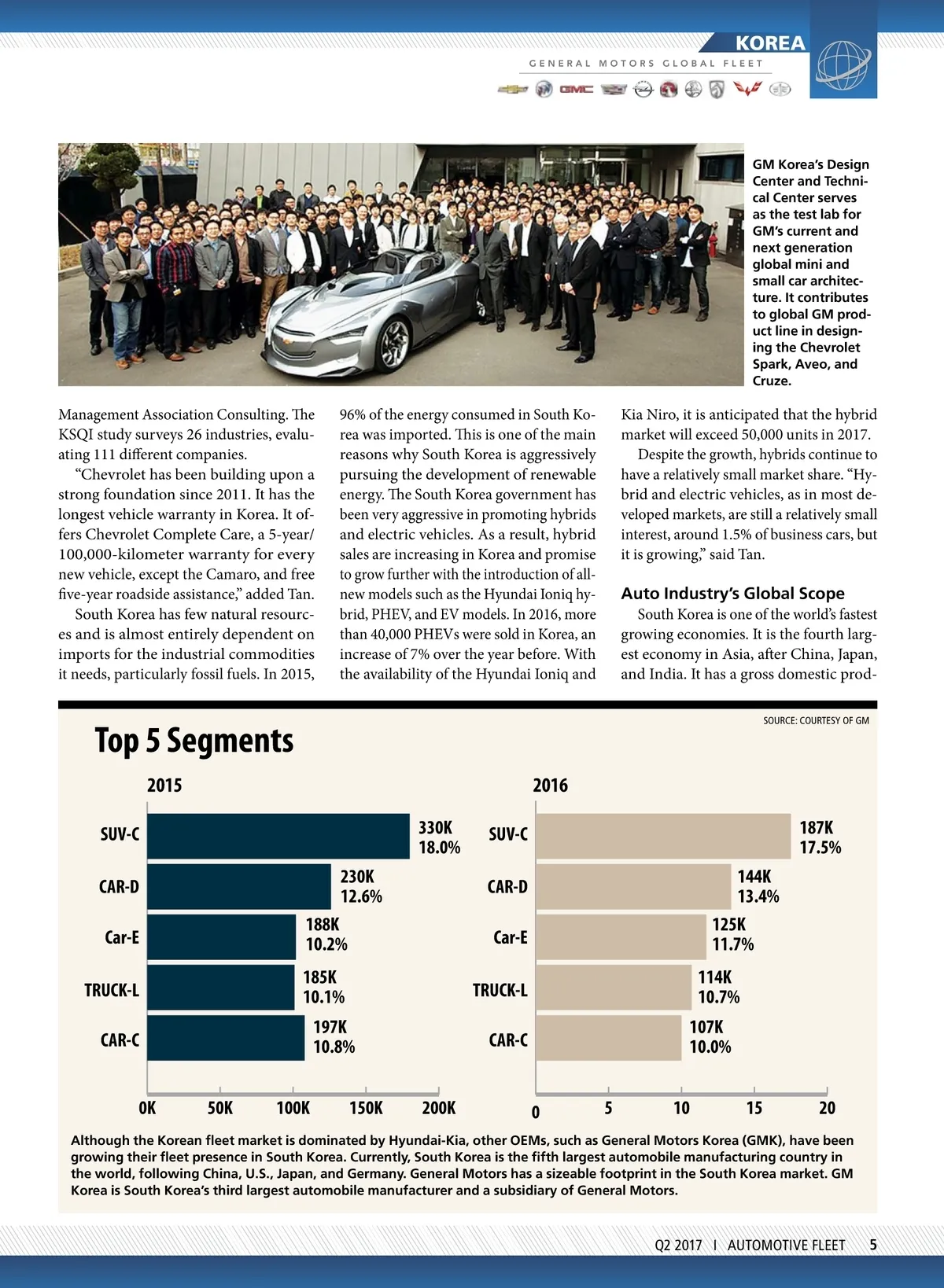
KOREA The State of the Commercial Fleet Market in South Korea PHOTO: ©ISTOCKPHOTO.COM/DABOOST The corporate leet sector in South Korea accounts for 18-20% of total auto sales, with most sales going to local brands. However, GM Korea is growing its leet presence, with commercial sales now representing 9% of total sales. BY MIKE ANTICH T he business vehicle sector in South Korea accounts for 10% of the country’s automotive market. In 2016, there were 3,859,991 vehi-cles manufactured in South Korea, of which 368,518 were sold as commercial vehicles. he majority of vehicles sold to commer-cial businesses were Korean brand man-ufacturers. Koreans have demonstrated a strong preference for local brands, as evi-denced by Hyundai-Kia having a 70% mar-ket share. Although South Koreans prefer domestic brands, more and more are look-ing to foreign marques as a way to stand out from the crowd, especially in the lux-ury segment. Foreign car sales have been increasing since South Korea signed free trade agreements with the U.S and Europe. Commercial Fleet Market In addition to local companies, there are approximately 7,500 multinational companies doing business in South Ko-rea. South Korea’s total workforce num-bers 25 million. Company cars in South Korea are as-signed to top management as part of their compensation package or as a tool of the trade for corporate salespeople. Hyundai’s recently-launched luxury sub brand Gen-esis has made inroads in the executive ve-hicle market with its EQ900 (G90 in other markets), outselling the Mercedes S-Class and E-Class models. In the business car segment, approxi-4 AUTOMOTIVE FLEET I Q2 2017 mately one-third of sales are for large sa-loon (four-door sedans) models, such as the Kia K7 and K9 or Hyundai Grandeur and Equus, demonstrating that prestige is an important factor in the South Ko-rean executive vehicle market. Kore-ans are fond of traditional four-door saloons as demonstrated by the instantly successful Renault Samsung SM6. How-ever, as elsewhere in the world, SUVs are gaining in popularity. For corporate sales leets, Korean sales representatives typically drive a Hyun-dai Sonata (called i40 in other markets) or K5 (which carries the Optima brand-name overseas). In addition to the Sona-ta, other popular leet cars in Korea are the Hyundai Avante (called Elantra in oth-er markets) and the Kia Sorrento (SUV). Other models making inroads in the Ko-rean leet market are the Ssangyong Tivoli (a compact SUV), the Kia K7 or (Caden-za, a luxury saloon), and the city car Chev-rolet Spark. However, the best-selling model in South Korea is the Hyundai Porter, a light com-mercial vehicle (LCV). Although the Korean leet market is dominated by Hyundai-Kia, other OEMs, such as General Motors Korea (GMK), have been growing their leet presence in South Korea. Currently, commercial sales represent 9% of GM Korea’s total sales, ac-cording to Audrey Tan, corporate key ac-count manager sales, service & marketing for General Motors International. For instance, GMK leet sales volume in 2016 increased by 6%. “he GMK leet team drove more sales by developing new customers and fully leveraging former dealers’ accounts,” said Tan. “Sales agents put more focus on small-medium sized enterprises and local-based rental/leasing companies.” Traditionally, the sales network of Ko-rean OEM manufacturers, e.g., Hyundai, Kia and Renault Samsung, is comprised of both their corporate sales branches and contracted sales agents. “Recently, GMK changed to sales agents,” said Tan. “For GM Korea, we only have sales agents and not owned sales branches.” Another factor stimulating GM Korea’s sale growth has been its growing reputa-tion of service quality among Korean con-sumers. For example, Chevrolet has been named No. 1 on the Korean service quali-ty index for sales service for four consecu-tive years. he Korean Service Quality In-dex (KSQI) study is conducted by Korea
Automotive Fleet May 2017: Page 4