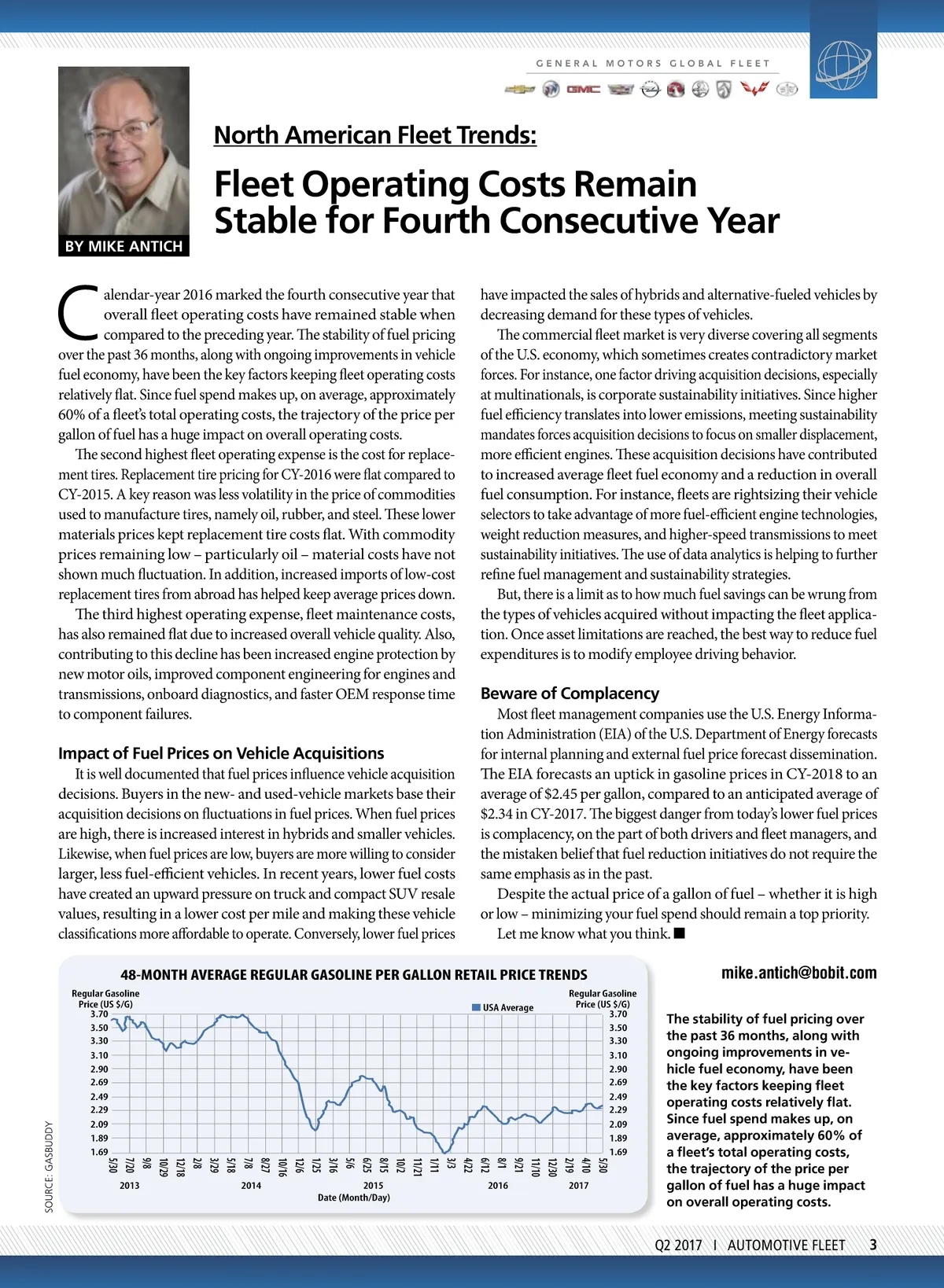
North American Fleet Trends: BY MIKE ANTICH Fleet Operating Costs Remain Stable for Fourth Consecutive Year have impacted the sales of hybrids and alternative-fueled vehicles by decreasing demand for these types of vehicles. he commercial leet market is very diverse covering all segments of the U.S. economy, which sometimes creates contradictory market forces. For instance, one factor driving acquisition decisions, especially at multinationals, is corporate sustainability initiatives. Since higher fuel eiciency translates into lower emissions, meeting sustainability mandates forces acquisition decisions to focus on smaller displacement, more eicient engines. hese acquisition decisions have contributed to increased average leet fuel economy and a reduction in overall fuel consumption. For instance, leets are rightsizing their vehicle selectors to take advantage of more fuel-eicient engine technologies, weight reduction measures, and higher-speed transmissions to meet sustainability initiatives. he use of data analytics is helping to further reine fuel management and sustainability strategies. But, there is a limit as to how much fuel savings can be wrung from the types of vehicles acquired without impacting the leet applica-tion. Once asset limitations are reached, the best way to reduce fuel expenditures is to modify employee driving behavior. C alendar-year 2016 marked the fourth consecutive year that overall leet operating costs have remained stable when compared to the preceding year. he stability of fuel pricing over the past 36 months, along with ongoing improvements in vehicle fuel economy, have been the key factors keeping leet operating costs relatively lat. Since fuel spend makes up, on average, approximately 60% of a leet’s total operating costs, the trajectory of the price per gallon of fuel has a huge impact on overall operating costs. he second highest leet operating expense is the cost for replace-ment tires. Replacement tire pricing for CY-2016 were lat compared to CY-2015. A key reason was less volatility in the price of commodities used to manufacture tires, namely oil, rubber, and steel. hese lower materials prices kept replacement tire costs lat. With commodity prices remaining low – particularly oil – material costs have not shown much luctuation. In addition, increased imports of low-cost replacement tires from abroad has helped keep average prices down. he third highest operating expense, leet maintenance costs, has also remained lat due to increased overall vehicle quality. Also, contributing to this decline has been increased engine protection by new motor oils, improved component engineering for engines and transmissions, onboard diagnostics, and faster OEM response time to component failures. Beware of Complacency Most leet management companies use the U.S. Energy Informa-tion Administration (EIA) of the U.S. Department of Energy forecasts for internal planning and external fuel price forecast dissemination. he EIA forecasts an uptick in gasoline prices in CY-2018 to an average of $2.45 per gallon, compared to an anticipated average of $2.34 in CY-2017. he biggest danger from today’s lower fuel prices is complacency, on the part of both drivers and leet managers, and the mistaken belief that fuel reduction initiatives do not require the same emphasis as in the past. Despite the actual price of a gallon of fuel – whether it is high or low – minimizing your fuel spend should remain a top priority. Let me know what you think. ■ Impact of Fuel Prices on Vehicle Acquisitions It is well documented that fuel prices inluence vehicle acquisition decisions. Buyers in the new-and used-vehicle markets base their acquisition decisions on luctuations in fuel prices. When fuel prices are high, there is increased interest in hybrids and smaller vehicles. Likewise, when fuel prices are low, buyers are more willing to consider larger, less fuel-eicient vehicles. In recent years, lower fuel costs have created an upward pressure on truck and compact SUV resale values, resulting in a lower cost per mile and making these vehicle classiications more afordable to operate. Conversely, lower fuel prices 48-MONTH AVERAGE REGULAR GASOLINE PER GALLON RETAIL PRICE TRENDS Regular Gasoline Price (US $/G) 3.70 3.50 3.30 3.10 2.90 2.69 2.49 2.29 2.09 1.89 1.69 2013 2014 2015 Date (Month/Day) ■ USA Average Regular Gasoline Price (US $/G) 3.70 3.50 3.30 3.10 2.90 2.69 2.49 2.29 2.09 1.89 1.69 2017 mike.antich@bobit.com The stability of fuel pricing over the past 36 months, along with ongoing improvements in ve-hicle fuel economy, have been the key factors keeping leet operating costs relatively lat. Since fuel spend makes up, on average, approximately 60% of a leet’s total operating costs, the trajectory of the price per gallon of fuel has a huge impact on overall operating costs. SOURCE: GASBUDDY 5/30 4/10 2/19 12/30 11/10 9/21 8/1 6/12 4/22 3/3 1/11 11/21 10/2 8/15 6/25 5/6 3/16 1/25 12/6 10/16 8/27 7/8 5/18 3/29 2/8 12/18 10/29 9/8 7/20 5/30 2016 Q2 2017 I AUTOMOTIVE FLEET 3
Automotive Fleet May 2017: Page 3