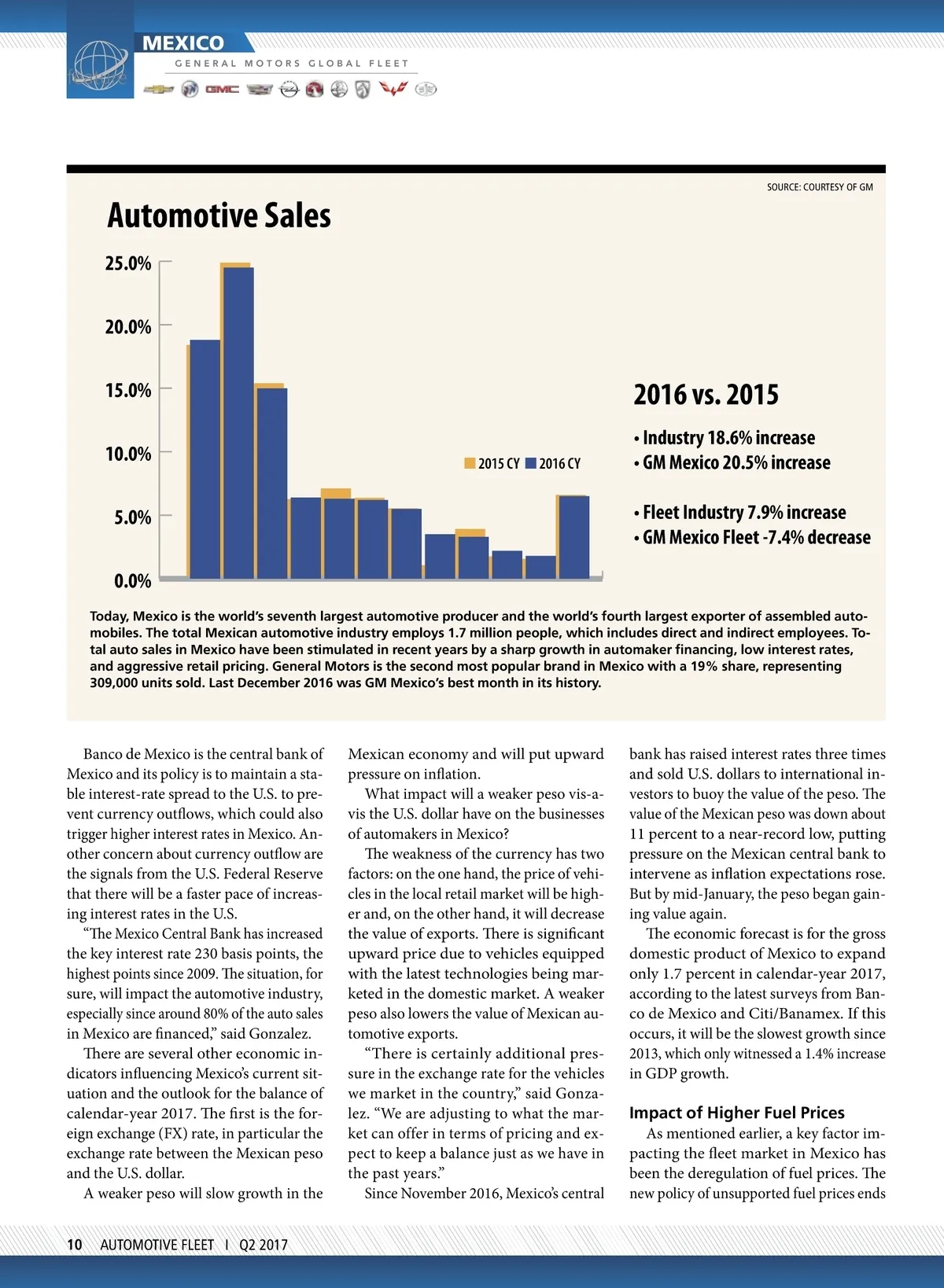
MEXICO feature SOURCE: COURTESY OF GM Automotive Sales 25.0% 20.0% 15.0% 10.0% 5.0% 0.0% Today, Mexico is the world’s seventh largest automotive producer and the world’s fourth largest exporter of assembled auto-mobiles. The total Mexican automotive industry employs 1.7 million people, which includes direct and indirect employees. To-tal auto sales in Mexico have been stimulated in recent years by a sharp growth in automaker inancing, low interest rates, and aggressive retail pricing. General Motors is the second most popular brand in Mexico with a 19% share, representing 309,000 units sold. Last December 2016 was GM Mexico’s best month in its history. 2016 vs. 2015 ■ 2015 CY ■ 2016 CY • Industry 18.6% increase • GM Mexico 20.5% increase • Fleet Industry 7.9% increase • GM Mexico Fleet -7.4% decrease Banco de Mexico is the central bank of Mexico and its policy is to maintain a sta-ble interest-rate spread to the U.S. to pre-vent currency out lows, which could also trigger higher interest rates in Mexico. An-other concern about currency outlow are the signals from the U.S. Federal Reserve that there will be a faster pace of increas-ing interest rates in the U.S. “he Mexico Central Bank has increased the key interest rate 230 basis points, the highest points since 2009. he situation, for sure, will impact the automotive industry, especially since around 80% of the auto sales in Mexico are inanced,” said Gonzalez. here are several other economic in-dicators inluencing Mexico’s current sit-uation and the outlook for the balance of calendar-year 2017. he irst is the for-eign exchange (FX) rate, in particular the exchange rate between the Mexican peso and the U.S. dollar. A weaker peso will slow growth in the 10 AUTOMOTIVE FLEET I Q2 2017 Mexican economy and will put upward pressure on inlation. What impact will a weaker peso vis-a-vis the U.S. dollar have on the businesses of automakers in Mexico? he weakness of the currency has two factors: on the one hand, the price of vehi-cles in the local retail market will be high-er and, on the other hand, it will decrease the value of exports. here is signiicant upward price due to vehicles equipped with the latest technologies being mar-keted in the domestic market. A weaker peso also lowers the value of Mexican au-tomotive exports. “There is certainly additional pres-sure in the exchange rate for the vehicles we market in the country,” said Gonza-lez. “We are adjusting to what the mar-ket can offer in terms of pricing and ex-pect to keep a balance just as we have in the past years.” Since November 2016, Mexico’s central bank has raised interest rates three times and sold U.S. dollars to international in-vestors to buoy the value of the peso. he value of the Mexican peso was down about 11 percent to a near-record low, putting pressure on the Mexican central bank to intervene as inlation expectations rose. But by mid-January, the peso began gain-ing value again. he economic forecast is for the gross domestic product of Mexico to expand only 1.7 percent in calendar-year 2017, according to the latest surveys from Ban-co de Mexico and Citi/Banamex. If this occurs, it will be the slowest growth since 2013, which only witnessed a 1.4% increase in GDP growth. Impact of Higher Fuel Prices As mentioned earlier, a key factor im-pacting the leet market in Mexico has been the deregulation of fuel prices. he new policy of unsupported fuel prices ends
Automotive Fleet May 2017: Page 10